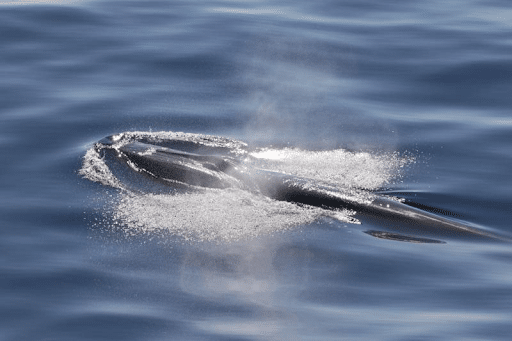
A critically endangered Rice whale surfaces in the northeastern Gulf of Mexico. Photo courtesy of NOAA Fisheries (NMFS ESA/MMPA Permit No. 14450).
AS FEDERAL POLICY NARROWS THE LEGAL DEFINITION OF “HARM,” SPECIES LIKE THE RICE’S WHALE FACE AN UNPRECEDENTED SURVIVAL CRISIS MASKED BY SHORT-TERM ECONOMIC DEVELOPMENT.
*Jaleel Brown-Howard was a student in the College Now Introduction to Journalism class at the City College of New York.
Impending environment destruction is not a distant, textbook debate anymore. It is a full-blown crisis happening right now. This month, the US Fish and Wildlife Service and the Department of the Interior finalized sweeping regulatory rollbacks to the Endangered Species Act. This newly finalized federal policy change completely alters historical protections, using the recent Supreme Court ruling in Loper Bright v. Raimondo as a primary legal justification to reshape how federal wildlife laws are enforced across the country.
The administrative rewrite, which went into effect immediately following its publication in the Federal Register, represents one of the most significant structural overhauls to the landmark 1973 conservation law in decades. While federal officials defend the updates as a necessary measure to reduce bureaucratic red tape and streamline infrastructure projects, environmental law experts warn the change systematically dismantles habitat-level protections.
By officially narrowing the legal definition of “harm,” the federal government has essentially declared that industrial operations can legally degrade or alter critical habitats, provided they do not directly injure or kill an individual animal on the spot. According to legal analyses tracked by the Harvard Environmental & Energy Law Program, this shifts a massive amount of oversight away from federal land managers and creates wide legal loopholes for commercial development.
To understand what this policy change could actually mean outside of a courtroom, it’s helpful to look at the Gulf of Mexico, home to one of the most endangered marine mammals in US waters: the Rice’s whale.
Rice’s whale is an extraordinary creature. As one of the only baleen whale species resident year-round in the waters of the United States, it has existed in the Gulf of Mexico for millennia. Yet, international data from the IUCN Red List classifies the Rice’s whale as critically endangered, and official updates from the Marine Mammal Commission reveal a stark, terrifying reality: there are likely fewer than 51 of these individual whales left on Earth. Under the original intent of the Endangered Species Act enacted in 1973, protecting an endangered species meant protecting the entire ecosystem it relies on to eat, communicate, and reproduce. Under those foundational rules, actions that severely degraded a species’ critical habitat, such as heavy industrial noise pollution, chemical runoff, or spatial encroachment, were legally classified as a “take” because they caused harm by disrupting essential behavioral patterns.
Conservationists argue that lifting these protections targets the exact industrial factors driving the species toward a population collapse. “Oil and gas is the biggest single threat to the survival of Rice’s whales,” said Christian Wagley, an environmental advocate tracking Gulf ecosystems. Wagley explained that industrial activities impact the mammals through a combination of seismic survey noise, increased shipping traffic, and heightened collision risks. “One of the leading causes of death for all whales worldwide, including Rice’s whales, is accidental ship strikes,” he added.
The removal of federal oversight also escalates the long-term risk of catastrophic environmental failure in the region, drawing comparisons to previous habitat disruptions. “The final threat is the chance of another devastating spill, like the BP disaster in 2010, which led to a 22% decline in the population of the whales,” Wagley noted, warning that the remaining population cannot endure further habitat degradation. “To have exempted companies from having to protect Rice’s whales… is a huge decision that will further push us toward extinction of the whales if it’s not reversed.”
The recent federal move upends decades of statutory precedent. In the landmark 1995 Supreme Court case Babbitt v. Sweet Home Chapter of Communities for a Great Oregon, the Court explicitly ruled that the Secretary of the Interior reasonably defined “harm” to include significant habitat modification or degradation that actually kills or injures wildlife by impairing essential behavioral patterns.
For nearly thirty years, this judicial precedent anchored federal conservation efforts, giving agencies the legal authority to halt commercial projects that compromised the long-term viability of an ecosystem. However, the legal landscape shifted dramatically when the Supreme Court overturned Chevron deference, stripping federal agencies of their authority to interpret ambiguous statutory language. This shift effectively left older environmental precedents vulnerable to challenges.
However, under the new administrative rewrite published in the Federal Register, unless an industrial activity results in immediate, visible physical injury or direct mortality to a specific animal, the habitat degradation itself is much harder to regulate or halt. For a population at potential risk of extinction, this legal distinction is not a minor semantic debate, it is a matter of absolute survival.
National policy experts argue that this standard directly subverts decades of established legal protections by prioritizing industrial development over critical ecosystems. “These weak Endangered Species Act rules continue the pattern of distorting the law and sidelining science,” stated Jewel Tomasula, National Policy Director at the Endangered Species Coalition. Tomasula warned that rewriting the legal definition of harm effectively creates a massive corporate loophole, making it significantly harder to enforce the protective standards historically upheld by cases like Babbitt v. Sweet Home. “The Endangered Species Act has prevented extinction for 99% of the species protected by it, but policies like these rules make it harder to protect our nation’s cherished wildlife, from Monarch butterflies to wolverines to sea turtles and more,” Tomasula added.
The stakes surrounding Rice’s whale became even higher following a highly controversial move involving a rarely used federal panel, often called the “God Squad.” Officially known as the Endangered Species Committee, this panel holds the ultimate authority to grant explicit exemptions to federal agencies and private corporations, allowing projects to proceed even if they endanger a species’ survival. Investigative reporting by NPR confirmed that this panel officially voted to grant an exemption to oil and gas drilling operations in the Gulf, meaning energy companies are no longer required to halt high-impact offshore activities specifically to protect marine life in those designated zones. As noted in legal briefs tracking the Endangered Species Committee Exemption for Gulf Oil and Gas Activities, this ruling directly strips away protective mandates across the whale’s core habitat space.
For the Rice’s whale, industrial noise from seismic airgun blasting, used by energy companies to map the ocean floor, can travel for thousands of miles underwater. According to acoustics studies published in The Journal of the Acoustical Society of America, this intense acoustic pollution disrupts the whales’ ability to communicate, navigate, and locate food. Under historical ESA interpretations, causing this level of environmental disturbance inside a critical habitat zone was recognized as actionable harm. Under the new post-Loper Bright regulatory landscape, where administrative agencies face reduced authority to enforce broader habitat standards, these industrial activities can expand with far fewer federal speedbumps.
On the ground, regional organizers and youth environmental coalitions are stepping up to bridge the gap between complex legal filings and public awareness. To understand the immediate human reaction to these rolling transformations, urgent outreach has been initiated with local grassroots networks. While formal statements are currently being collected from regional student coalitions, grassroots groups are already responding by pivoting toward local legislative action, state-level environmental protections, and public literacy campaigns. By breaking down dense legal jargon into clear, relatable concepts, journalists and regional advocates are showing communities how federal court rulings directly impact the local waters right off their coasts.
“It is disheartening to realize that rules let companies ruin habitats as long as they don’t kill on the spot,” says an outreach leader with Sustained Abilities, a national network of organizations dedicated to protecting wildlife and wild places. “We are facing ignored public comments and a broken system. Our biggest hurdle now is making regular people care about a whale thousands of miles away, but if federal policy fails the Rice whale, no local ecosystem is safe.”
Analyzing open-source NOAA Fisheries Species Directory data alongside spatial data tracking models from the Marine Mammal Commission Geographic Information System maps out a plain reality: when corporate exemptions combine with narrowed habitat definitions, the Rice’s whale’s last remaining safe zones shrink almost instantly.
By using Loper Bright v. Raimondo to narrow the legal definition of harm, federal policy has created a system where an entire species can be driven to the brink of extinction through gradual habitat destruction, all while staying technically compliant with the law. When an ancient ecosystem is dismantled piece by piece for short-term gain, the loss can be irreversible.
Advocates fighting on the front lines warn that waiting for a perfect legal challenge means running out of time for the wildlife trapped in the crosshairs of policy changes.
“We are no longer just fighting to protect a species; we are fighting a system that legalizes its erasure,” says an outreach leader with Sustained Abilities. “If federal policy can minimize the destruction of an entire marine habitat down to a minor compliance issue, then the law isn’t protecting the environment—it’s just providing a legal roadmap for its extinction.”
Series: High School Journalists