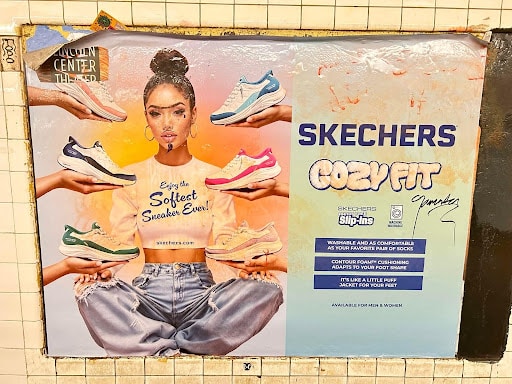
An AI-generated Sketchers ad vandalized in a subway station, located in Brooklyn on the G line. Photo by Victoria Renee Johnson.
TEENAGE ARTISTS AND WRITERS VOICE THEIR CONCERNS ABOUT GENERATIVE AI AS MORE AND MORE COMPANIES OPT IN.
*Victoria Renee Johnson was a student in the College Now Introduction to Journalism class at the City College of New York.
Jayela Addison, a 17-years-old artist, is convinced that there is at least one thing Artificial Intelligence can’t steal from her and her fellow creatives’ work: Passion.
“You’re just clicking a prompt into an AI generator and then it gives you something. It gives you what you ask for. It lacks emotion. It lacks passion. It was something done out of pure laziness. And to say you do art means you actually sat down and did it and drew it,” Jayela answered when asked if ‘AI artists’ were real artists.
Margaret is a 16-year-old student at Midwood High in Brooklyn. Before the huge generative AI spike, her school used to have handmade posters created by staff. After the spike, AI posters have taken their place. “What are you doing? I know you guys have made posters without this before. It’s not a necessary step or a tool that you need to have,” Margaret said. “And,” she continued, “a school is nothing without its students. So why not involve your students in the process of what decorates our school, and so many students hate how it looks.”
Margaret wrote a letter addressed to her principal, discussing a possible removal of the posters. Unfortunately, the principal had not taken any action to take down said posters, leaving Margaret unsatisfied but not undetermined.
Jasmine, another young creative, thinks that “art at its core is the heart and soul being put into creating it.” Art, she said, “is the process and all the grueling hours put in for the product, and art is the combination of an imaginative mind and a passionate heart,”
There’s been a growing concern in recent years among young artists and writers about their careers due to more and more companies opting for AI generated artworks, scripts, and other types of media. These recent developments have sparked major backlash in the form of protests, such as the WGA and SAG-AFTRA strikes in 2023 which brought the industry to a major pause.
More often than not younger audiences are increasingly interacting with AI; data from a September 2025 survey conducted by Pew Research Center showed that around 62% of respondents under 30 have heard a lot about AI, compared to 32% of participants older than 65. Yet, younger people, specifically artists and consumers, are actively fighting against the rise of generative AI and its harmful effects on their professional careers.
Generative AI has long existed, well before the 2020s. The chatbot Eliza being one of those first, created back in 1966. These models opted for statistical learning models that were trained off of data, like what we see now. An article on Dataversity states, “The years 2023 through 2025 represent one of the most rapid periods of advancement in the history of generative AI.” During this time, the article continues, “generative AI evolved from an emerging technology into a transformative tool used widely across industries.”
According to the Interactive Advertising Bureau in January of 2026, “AI usage in advertising continues to rise. Over 80 of ad executives now say their company has deployed AI in the creative process, up from 60% in the 2024 study.” Sketchers is a high profile example, their AI ads have been spotted all across NYC’s subway stations, getting an infamous reputation among consumers.
Artists and writers alike are resisting generative AI for it nonconsensually using other peoples’ work and turning it into ‘slop.’
Franceso Agninelli, a digital and data studies lecturer, raises what he considers to be an, “important point.” “AI models,” he writes, “are increasingly trained on datasets that include not only human writing but also AI-generated and human–AI co-produced text.”
Margaret said that because “AI was trained off of artists’ work” it is “stealing artists’ work and merging it together because it’s not AI that can create something new entirely. It takes from other artists that it found online without artist consent.”
Generation platforms such as Midjourney and Deviant Art have been under scrutiny for taking real life artists’ work to train their machines on. As recently as 2024, lists have been revealed to the public with over 4,000 artists named whose art was being used to perform said tasks, resulting in a lawsuit against these companies. NBC and Reuters reported that Sarah Andersen, Kelly McKernan, and Karla Ortiz are suing the aforementioned companies for infringing on their copyright. As of July of 2026, the case is on hold, and will resume in February of 2027.
This scrutiny doesn’t only come from creatives, but the general public as well. “Many Americans worry that AI could exacerbate inequality, threaten jobs, infringe on privacy, or make opaque decisions with serious consequences, often without meaningful human oversight,” a Cornell University blog reads. As one woman in her 70s was quoted by Cornell University: “It will eventually eliminate jobs. Then what will those people do to survive?”
These frustrations have reflected back onto real life, through strikes (such as SAG-AFTRA), vandalism of AI media, and the isolation of self-proclaimed ‘AI artists’ in the art community. Creative spaces have been divided on if AI artists are real or simply posers.
Kelli, a 16-year-old Manhattan-based writer, told me that “they cannot claim to be a real artist until they’ve done it themselves.”
AI has no plans of slowing down soon, only increasing in corporate value.
It’s unclear if people will acknowledge the harmful effects of generative AI until it specifically harms themThough Margaret, Jasmine, Kelli, and Jayela aren’t waiting. They already have made up their minds.;
Jasmine and Kelly suggest limiting the usage of generative AI, cracking down on it and having regulations against it, while Margaret and Jayela conclude unity is needed in creative spaces before they tackle the bigger issue.
Jasmine was blunt. She’s “disgusted.” “It automatically makes me look down on them as a person. It’s a pathetic thing to do,” she said, adding, “they are truly a lost cause festered only from the pits of our absolute stupidity.”
Generative AI, she continued, “gives us absolutely no benefit, we lose nothing from having it banned, yet simply having it available to the public not only damages our environment, but also damages the livelihood of artists and the safety of citizens online. It’s a dangerous, high risk, no reward gamble.”
Series: High School Journalists