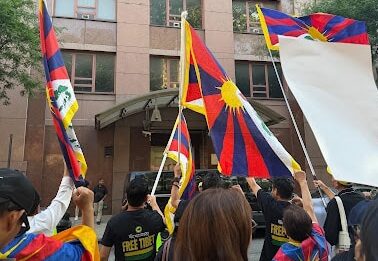
Protestors wave the Tibetan flag in front of the United Nations. Photo by Tenzin Palkyi.
A TIBETAN AMERICAN STUDENT DISCUSSES HER EXPERIENCES WITH THE ACTIVIST GROUP FREE TIBET.
*Tenzin Palkyi was a student in the College Now Introduction to Journalism class at the City College of New York.
Standing among hundreds of protestors in New York City, Tibetan American students joined calls to ensure human rights in Tibet. Through the activism of Students For A Free Tibet, Tenzin Dolkar, 15, hopes demonstrations like this will educate the public and encourage international support for the Tibetan people.
Dolkar said she wants to “bring awareness and educate the people who may not be aware of Tibet’s circumstances.” “These protests,” she added, “also want the Chinese Communist Party to liberate Tibet and be recognized by the world as their own individual country.”
An incoming junior in high school, Dolkar participates in an organization called Students For A Free Tibet. The organization is a global grassroots network of young people and activists campaigning for Tibet’s political independence. A nonprofit, it uses nonviolent direct action, education, and advocacy to protest Chinese rule and defend Tibetan human rights, culture, and environment.
I spoke with Dolkar at a protest on July 15 at the United Nations. The demonstration brought together Tibetans, human rights advocates, and supporters from across New York City to call attention to the ongoing human rights concerns in Tibet.
Tibet remained under the Chinese government’s control in 1950; the Seventeen Point Agreement led for Tibetans to flee their own country after the Chinese control of Tibet. Over 70 years later, Tibetans don’t have religious and language rights. They have to live under Chinese occupation, in schools they are forced to learn Mandarin, and religious activities are regulated by the government. Chinese officials have also limited freedom of speech, religion, and cultural expression, leading many Tibetans both inside and outside Tibet to continue advocating for the preservation of their identity and basic freedoms.
For many young Tibetans, activism is about ensuring that future generations do not lose sight of their culture. Getting the youth involved with these demonstrations can bring broader attention to the cause, better understanding, and the rise in this new cohort of activists could impact the lives of the future generations of Tibetans. Growing up in New York City, Dolkar said she feels a responsibility to speak for Tibetans who are unable to protest and speak freely inside Tibet.
On July 1, China’s New Ethnic Unity Law came into effect. The law requires government agencies, schools, and public institutions to promote a shared Chinese national identity and strengthen ethnic unity through education and public policy. Chinese officials have noted they intend to promote equality, national unity, and social stability. Speaking with Tibetans, they believe these policies will reduce the Tibetan’s ability to preserve their own distinct language, religion, and culture.
The passing of this new law, Dolkar said, makes this “a crucial time to protest for Tibet.”
Lobga Rangzen was a 52 year old Tibetan who devoted his life for Tibetan independence. He was a well-known person in the Tibetan Community who advocated as an activist for independence. After the Chinese Unity Law took place, he took his final action on July 2, 2026. At 5:49PM, he immolated himself outside of the United Nations.
“Tibetans have been paying respect to the sacrifice [Rangzen] has made to draw attention to Tibet’s conflict,” Dolkar said, adding, “we are the future of what is held of Tibet so it’s important we start to be involved.” These protests, she noted, “have gained media attention and helped people learn about the circumstances within Tibet.”
As concerns over China’s new Ethnic Unity Law continue, Tibetan activists say they plan to keep organizing demonstrations, cultural events, and educational campaigns. They hope that increasing public awareness will encourage more people to learn about Tibet and support efforts to preserve Tibetan culture, religion, and identity.
While there is a prominent presence of activists in New York fighting for Tibet’s independence, this action is not only happening outside the United Nations in Manhattan. Since the passing of Pawo Lobga Rangzen, his activism has led Tibetan communities all around the world to continue their fight for Free Tibet.
The future of Tibet remains uncertain, yet activists and the younger generations of Tibetans remain consistent in organizing protests, educating others on the circumstances in Tibet, and helping to preserve their culture.
“We emphasize human rights when fighting for a Free Tibet because human rights in Tibet are violated consistently,” Dolkar told me. “We are the future generation, so our actions today will affect the future of Tibet.”
Tags: activism Lobga Rangzen protests tibet
Series: High School Journalists