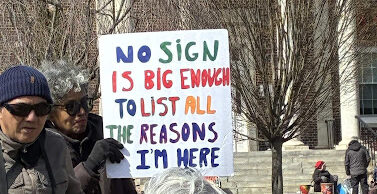
An anti-ICE protest in Teaneck, NJ. Photo courtesy of Max.
THREE HIGH SCHOOLERS RESPOND TO FEDERAL IMMIGRATION AGENTS’ PRESENCE NEAR THEIR HOMES.
*Raileen Gomez was a student in the College Now Introduction to Journalism class at the City College of New York.
Three small town New Jersey high school students, Simfany, Dakota, and Max are enraged with the presence of Immigration and Customs Enforcement agents in their towns. Recently, they each had their own interactions with ICE coming into their towns, Belleville and Teaneck—both towns taking up less than 10 square miles together. Though their encounters with ICE have been indirect, the high schoolers feel their presence came with threats and hostility to the locals.
“The way I think of ICE is more disgust than hatred,” Simfany said. “If you hate something you’ll do something about it to stop hating it.” “But for disgust,” she continued, “you’ll have a hard time to stop not liking that something bringing you to the feeling of disgust.”
Simfany is from the small town of Belleville, where there’s 10 public schools in the district. This year, federal immigration agents came to her high school, dwelling in the parking lot. “What am I supposed to do?” she asked, adding, “I don’t like how they’re targeting little kids.” A block away from her school is an elementary school and not so far away there’s another school. “Pretend the high school is not there,” Simfany raised, before saying that she thinks the agents “would have still stayed because of the elementary school being across the street.”
Simfany has expressed fear for her younger brother’s safety, along with her loved ones as well. Her and her family are US citizens—though she has African origins and worries that will make her a target. “Increasingly,” according to the American Immigration Council, “individuals in ICE detention are Black or come from majority-Black countries in Africa and the Caribbean.” It has been a nail biting experience, she explained, when she and her younger brother are heading home. Because of ICE’s close presence, they started to meet up more commonly before leaving school. Around the end of January, she had to stay after school for rehearsal and that meant she would be leaving much later than her brother, making her worry because that day ICE was around.
Dakota is from another small town in New Jersey, Teaneck, where there’s 8 public schools in the district. He’s an US citizen, along with his family, but similar to Simfany, Dakota is Latino—another group that has been a major target of ICE. When Dakota heard that a club at his high school was planning anti-ICE protests, he was intrigued and wanted to be a part of it. Dakota participated in three of his school’s protests, including when they walked around the community to spread awareness.
Before the protests, some teachers had given out “these tiny slips of yellow papers that explained what to do if ICE came to either our homes or if we were approached by ICE in our neighborhood,” Dakota explained. These slips of paper were a guide from the high school to those who were participating in the protest. “That we would even have to put that out so that students and staff won’t be taken by ICE,” Dakota said, was “absolutely disgusting.”
Max is another student from Teaneck who has gone to anti-ICE protests, both during and after school. A US citizen, Max’s family members are immigrants who gained their citizenships within the last 5-10 years. He too expressed concern of being a target to ICE, saying, “I’m only first generation along with my sisters so I fear we’re all at risk.” In response to seeing news of ICE picking up people off the street, Max said his mom installed cameras around the house and set an electric lock on the front of their house because of the fear.
“She doesn’t really feel safe with any of us, especially my sisters, being alone anywhere,” Max said.
There are currently six ICE Detention Facilities located in New Jersey. Recently, Delaney Hall has been being exposed for their inhuman treatment and neglect towards the many detained people. There have been reports of detained people not having access to proper food and medical attention, and facing unsanitary and abusive conditions, as protesters continue to advocate for the rights of people who were detained.
Federal immigration agents have continued to detain those a part of some of the most vulnerable communities; children and students, pregnant women, and the elderly. ICE agents have also been targeting workplaces, a church, and other public spaces across New Jersey.
After learning about what has been done in their communities, all three of the students I spoke with felt the need to protest or speak up to the best of their abilities. Dakota felt the responsibility to show up for his neighbors and friends. “I felt like it was my duty to protest even in the snow,” he said. “Low risk for a higher reward.”
Tags: ICE Immigration new jersey protests
Series: High School Journalists