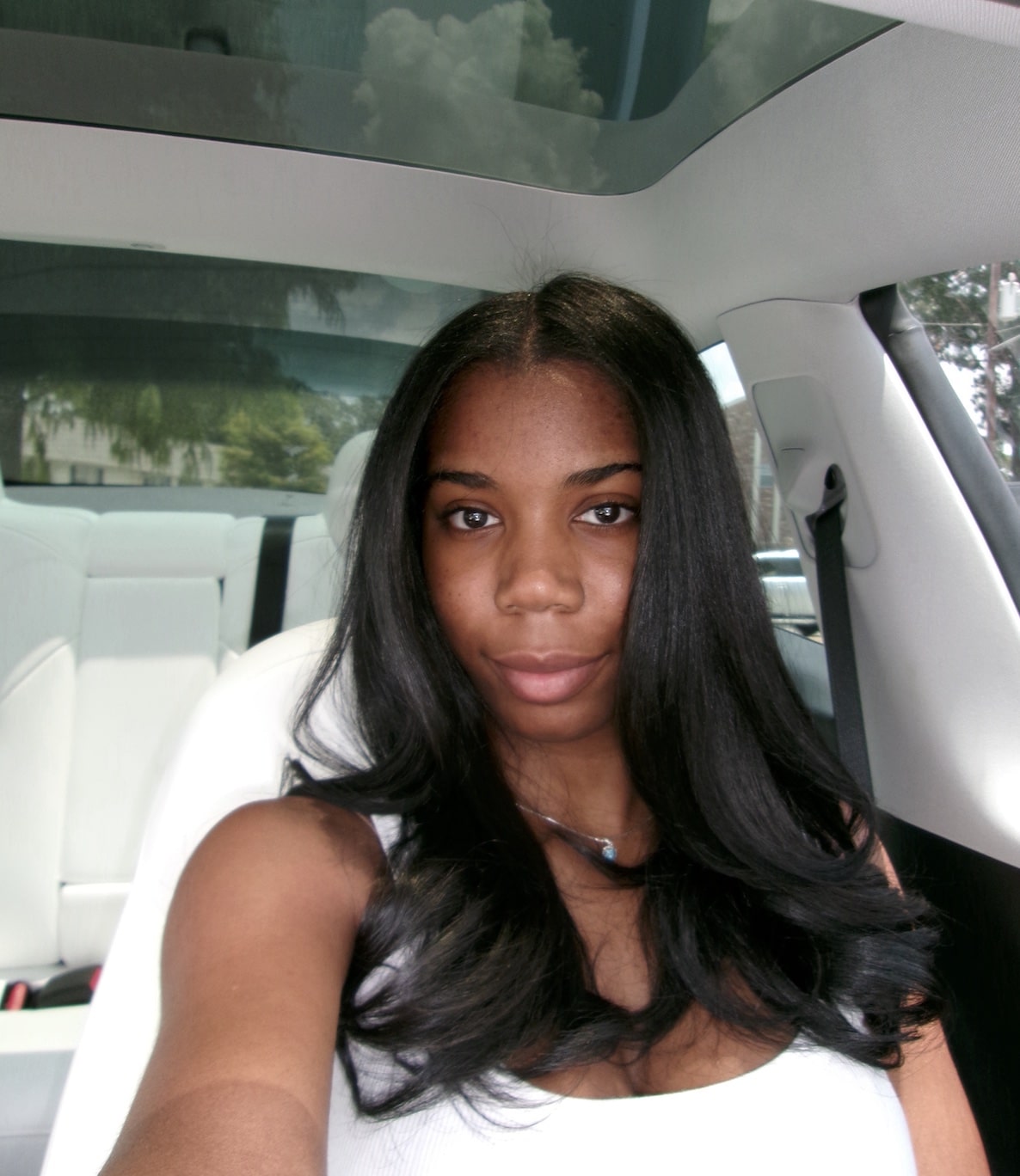
Imani Holliday selfie.
As a child growing up in The Bronx, Cinia Simpson dreaded hair wash day. “It was a tense time,” the City College of New York (CCNY) student said. “They didn’t want to do my hair. I didn’t want them to do my hair.” What started as long detangling sessions with family members slowly became tied to something deeper: shame, identity, and questions about beauty standards. Simpson said that growing up, she often avoided hairstyles that made her feel “too African or too Black,” choosing styles she believed looked more socially acceptable.
Years later, scrolling through YouTube videos changed the way she saw herself. Watching Black creators document their wash routines, curl patterns, and styling techniques exposed Simpson to the idea that textured hair is something to celebrate rather than to correct. One creator she followed, a Georgia-based hairstylist known online as AfrikanGod, inspired her because he styled his natural hair without relying on extensions or altering its texture through heat.
For women and men, Black hair goes to the core of their identity, and they spend a lot of time and money on hair care and products. The global Black hair care business is a beneficiary of that. Black hair products bring in more than an estimated $3.3 billion and the market is expected to reach $5 billion by 2034, according to Dimension Market Research.
Beyond the products, social media has become more than entertainment for some Black women. Platforms like YouTube, Instagram, and TikTok helped reshape conversations about hair. They opened the door for Black creators to document their routines, challenge long-standing ideas about beauty, and normalize textured hair in ways traditional media failed to do
That shift is a part of a larger cultural phenomenon known as the natural hair movement. It encourages Black people to embrace Afro-texture hair in its natural state rather than chemically straightening it. The movement first gained visibility during the Civil Rights and Black Power era of the 1960s and 1970s that put the spotlight on people including Angela Davis, Kathleen Cleaver and Nina Simone. YouTube creators brought on a resurgence in the late 2000s and early 2010s documenting their “big chops,” curl routines, and stepping away from relaxers.
Hair influencer and digital creator Imani Holliday, 25, from Dallas, Texas, had a period when she was younger when her mother relaxed her hair to make it more “manageable.” She moved away from that to “straight natural.” Now she straightens her hair with silk presses and blow drying instead of chemicals. Holliday said she benefited from social media’s spotlight on Black hair.
“Being able to see so many women with different textures, lengths, and styles has been transformative,” Holliday said. “It made Black hair feel more accepted over time,”
Holliday said the internet helped push back against decades of messaging surrounding “good hair,” a phrase historically tied to looser curls and straighter texture associated with Eurocentric beauty standards.
“I think there is no such thing as ‘good hair,’” Holliday said. “There is healthy hair. If you love what you have, take care of it, that’s what good hair means.”
In Queens, New York, salon owner Shawnese Parker said she has watched the shift happen in her chairs. “In previous years, there was more emphasis on white hair, longer hair,” Parker said. “Now women are embracing afros, defined curls, and learning how to take care of what God gave them.”
That may be so. But employers don’t always embrace the natural movement, and even though 27 states have passed a version of the Crown Act outlawing discrimination of race-based hair styles, discrimination persists.
A 2026 study by Teen Vogue found that many Black women felt pressured to straighten their hair for interviews, presentations, and corporate environments. “We were told our hair needed to be well kept,” Ariel W., one of the women in the report said.
Black women want their hair to become accepted as hair any way they style it. “For Black women, our hair is debated, regulated, and legislated,” Imani Holliday, said. “I hope we reach a place where our hair is simply normalized and celebrated.”
Tags: black hair Black hair styles Black women love their hair importance of Black hairstyles Joan Andre natural Black hair styles
Series: Community