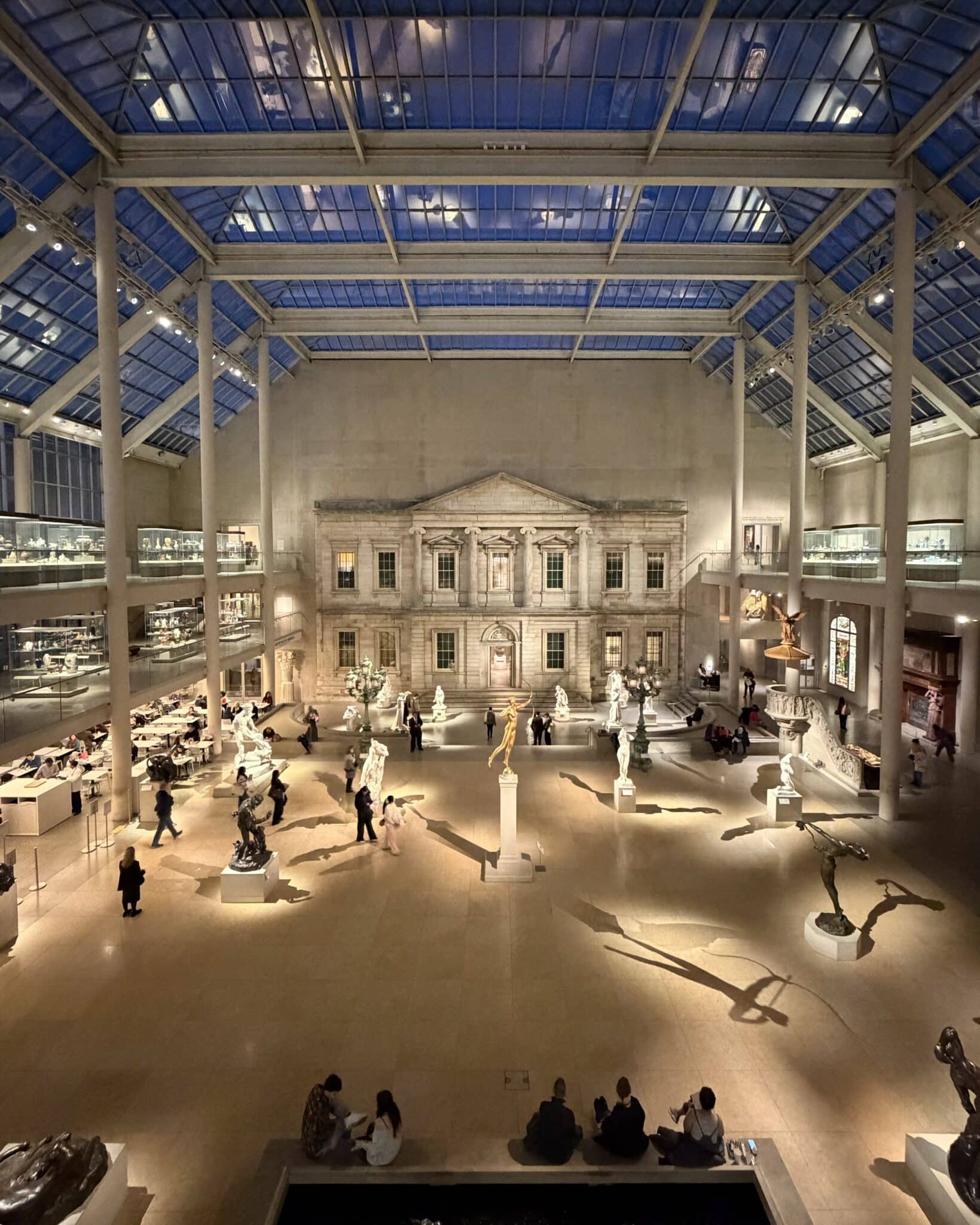
On the eastern edge of Central Park, stretching nearly a quarter mile along Fifth Avenue, the Metropolitan Museum of Art rises not simply as a building but as a living record of human civilization. For the Upper East Side, the Met is more than a prestigious neighbor; it is a cultural anchor that shapes the neighborhood’s identity and projects it onto the world stage.
For millions of visitors each year, it is a pilgrimage site where history, beauty, and human emotion converge in physical space. At a moment when art is increasingly consumed through screens—when global travel has been reshaped by digital access and post-pandemic realities—the Met’s continued relevance raises a central question: why do people still come here, in person, in such overwhelming numbers? The answer lies not only in the museum’s vast collection, but in its physical presence, its emotional impact, and its singular position as both a neighborhood institution and a global crossroads.
Founded in 1870 and first opened to the public in 1872 at 681 Fifth Avenue, the Met emerged from a distinctly American ambition: to create an encyclopedic museum that could stand alongside Europe’s great cultural institutions. By 1880, the museum had moved to its current location at the edge of Central Park, into a red-brick-and-stone structure designed by Calvert Vaux and Jacob Wrey Mould. That original building still exists, though today it is nearly invisible—enveloped by more than a century of architectural additions that mirror the museum’s expanding mission.
The Met’s physical growth tells a story of cultural urgency. In 1902, trustee and architect Richard Morris Hunt designed the monumental Beaux-Arts façade that now defines the museum’s public image, pushing the building forward to meet Fifth Avenue with confidence and grandeur. After Hunt’s death, McKim, Mead & White expanded the museum with north and south wings that dramatically increased gallery space. In 1971, a comprehensive master plan by Roche-Dinkeloo launched another era of transformation, resulting in six new wings over two decades. Today, the Met is more than twenty times larger than the building that opened in the nineteenth century.
The result is a structure that feels both monumental and porous. The main façade—dominated by four pairs of composite-order columns adorned with scrolls and acanthus leaves—signals authority and permanence. Visitors enter knowing they have stepped into a place where time stretches far beyond the present. But architecture alone does not explain the Met’s pull.
What defines the experience is how people move through the building—and how the building, in turn, shapes their emotional response. “It’s usually overwhelming, because there’s a lot to take in at once,” says Ezekiel Tek, a Visitor Experience Ambassador at the Met. “There are multiple ways to get in, and they’re a little unclear. We have a minimalist setup, and it’s not always obvious where things are.” That initial sense of disorientation is not a flaw; it is part of the museum’s design philosophy. “I think it’s kind of a funnel,” Tek says. “It encourages you to move around, because you can’t just see everything by going through one entrance.” The building resists efficiency. It demands wandering. That resistance is central to why the Met continues to draw visitors from around the world, even in an era when high-resolution images of its masterpieces are readily available online.
“I think digitalization has actually increased people’s desire for authentic experiences in the real world,” says Adam Eaker, the Met’s Howard Marks Curator of European Paintings. “Social media has also been incredibly effective in showing people what the museum has to offer and motivating them to come.” Inside the galleries, that desire for authenticity often deepens into something more intimate.
Nadya Bartolini, a Met tour guide, sees this transformation daily. “In a museum as immense as the Met, selecting stories is an act of thoughtful curation,” she says. “I begin by sensing a group’s curiosity, background, and emotional openness. With adults, I usually build a narrative thread across time, showing how art reflects universal human questions.”With children, she shifts gears entirely. “My approach becomes more playful and exploratory,” Bartolini explains. “I often design interactive quests that turn the museum into a treasure hunt. The Met becomes a giant puzzle, and each artwork a clue.” That flexibility is possible because of the museum’s encyclopedic scope. Visitors can move from Ancient Egypt to Renaissance Europe to modern America in minutes.
Custodian George Gauthier sees how this scale shapes first impressions. “Most visitors are looking for the Egyptian temple gallery,” he says. “That’s something that really draws people in.” What surprises them most, he adds, is the sheer size of the institution: “Four city blocks long—a place you can spend an entire day.” For many visitors, that scale becomes personal. A tourist from Germany, visiting for the first time, paused in the Great Hall and said, “I thought I would rush through it, but instead I feel like the building is slowing me down.” A New York college student described a different relationship: “I come here between classes. I don’t even need to see something new. I just sit in one gallery.”
That ability to hold both first-time awe and quiet routine allows emotional connections to form. Bartolini notices clear patterns in what resonates most deeply. “Visitors often gravitate toward artworks that mirror intimate, familiar aspects of human life,” she says. “Renoir’s paintings, for example, evoke warmth, community, and tenderness.” Children respond differently but just as strongly. “The Ancient Egyptian galleries are among their favorites,” Bartolini notes. “They love spotting tiny hieroglyphs, animals, and symbols. For them, the past feels alive—like a world waiting to be decoded.”
These reactions reveal what many visitors are truly searching for. “People ask questions that show a desire to understand not just the artwork, but the world that shaped it,” Bartolini says. “Standing before Bruegel’s The Harvesters, they often ask about daily life—work rhythms, communities, relationships to the land.” Sometimes the emotional impact is sudden. “During a quiet stop in front of van Gogh’s L’Arlésienne,” Bartolini recalls, “a visitor grew emotional, saying the woman’s expression reminded him of someone he had lost. In that moment, the gallery’s noise faded.”
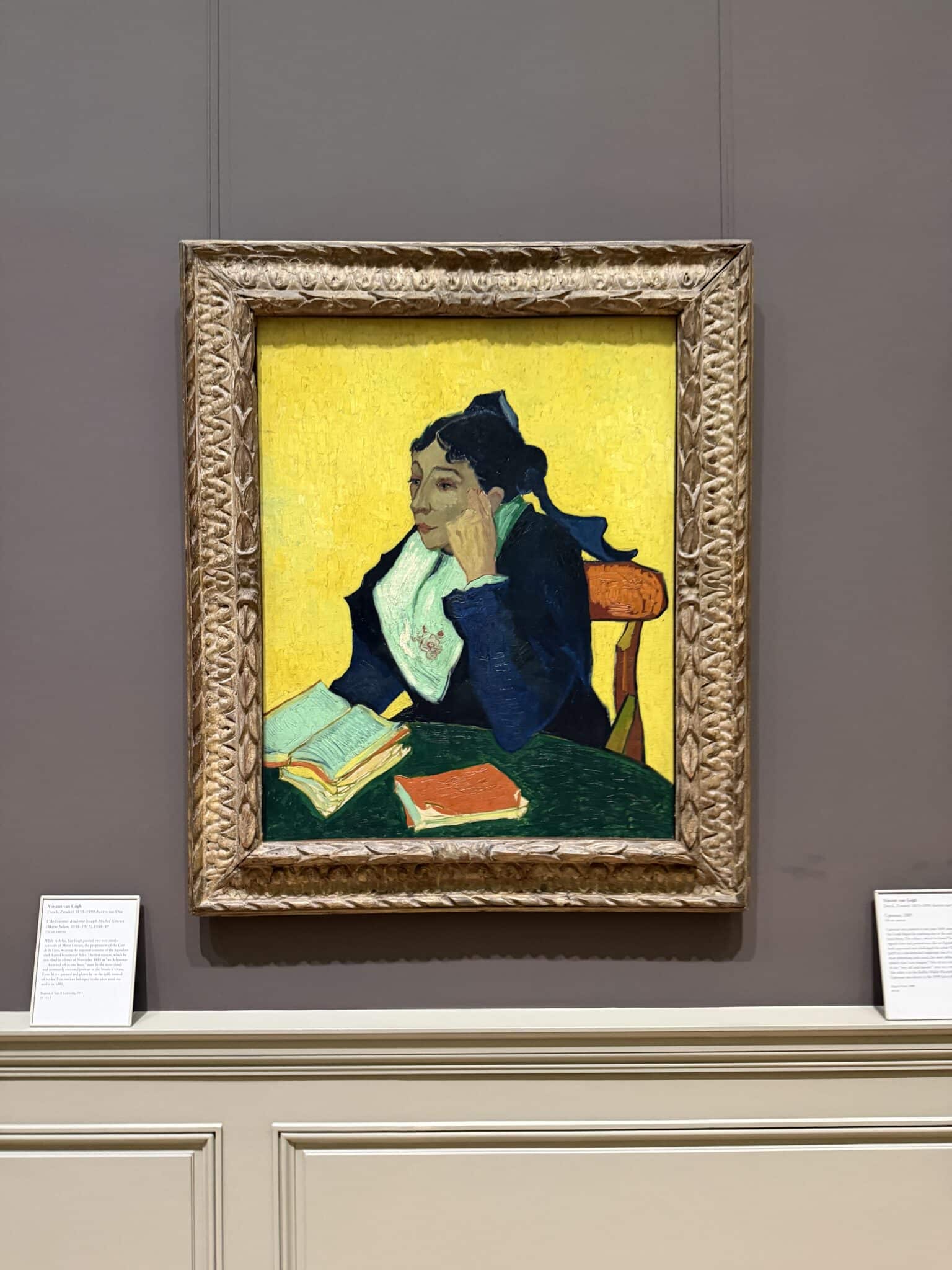
Van Gogh’s L’Arlésienne.
For the Met’s staff, these encounters reaffirm the museum’s relevance. “The Met offers more than masterpieces,” Bartolini says. “It offers perspective.” Standing before works like Sargent’s Portrait of Madame X, visitors confront universal themes—ambition, vulnerability, identity.
The museum’s layout helps make these encounters possible. “It’s almost labyrinthine,” Bartolini says, “and that shapes the experience like a journey through civilizations.” Curators value that sense of discovery as well. “One of the best things that can happen is stumbling across something unexpected,” Eaker says. “We hope for those moments of serendipity.” For Eaker, the museum is also deeply personal. “Passing familiar faces in portraits on my way to the office is a daily pleasure,” he says. One painting holds particular meaning: Anthony van Dyck’s Self-Portrait, which inspired his dissertation and appeared on the cover of his first book.
This blend of personal meaning and global significance cements the Met’s role as an UpperEast Side landmark. For local residents, it is not a special occasion—it is a daily presence. Joggers circle its steps at sunrise. Students gather on the plaza after school. Families return again and again, knowing they do not have to see everything at once. “It’s multifaceted,” Gauthier says. “From prehistoric times to European paintings, from Egypt to Greece and Rome, it appeals to all ages, across centuries.” That breadth distinguishes the Met from nearby institutions. “The Guggenheim focuses more on modern art,” Gauthier notes. “Its building is fascinating.” The Met, by contrast, positions itself as a cultural crossroads, where global history feels immediate and tangible.
Late in the afternoon, as light softens in the galleries, visitors slow their pace. A child lingers before an ancient statue. A couple stands quietly in front of a portrait. The Great Hall echoes more softly now. “The museum isn’t static,” Bartolini says. “It evolves through every pair of eyes that sees it.” In a city defined by constant change, the Metropolitan Museum of Art endures because it absorbs that change without losing its core identity. Its Fifth Avenue façade may stretch for blocks, but its true reach extends far beyond Manhattan—into the personal histories of those who pass through its doors, and into the shared human story it continues to tell.
Series: Community