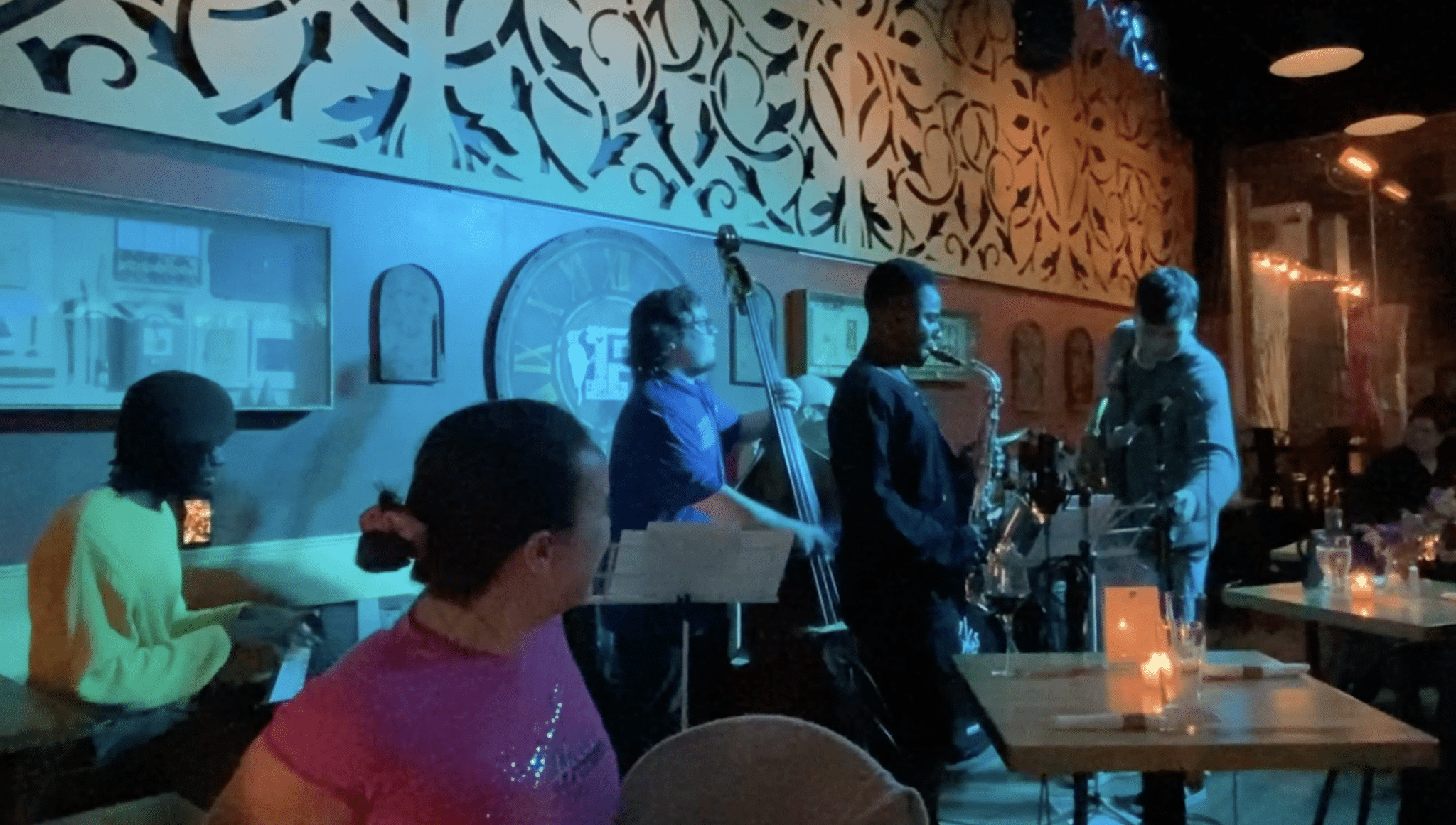
Graduate musicians playing at the CCNY Concert Series: Graduate Jazz Ensemble Recital. Photo credit: Samin Jabir
I sat with Mike Holober in his office, Shepard Hall 175. My knees bounced against the chair. My fingers tapped the desk, stopped, and started again. Sweat built under my hoodie and leather biker jacket, trapped between layers I hadn’t thought through. The room was spacious. A classic piano sat in the center, untouched. Sheets of paper were everywhere, on desks, chairs, the floor, nothing stacked neatly.
“Have you listened to jazz before?” he asked.
“Not really,” I said. “I listened to the Whiplash soundtrack.”
His eyes widened. His face went dead. The CCNY music professor did not look impressed.
“I-I-I know,” I said. “I know it isn’t accurate.”
“You probably don’t want to mention that to the people you’re interviewing,” he said. “Unless you want to get your balls busted.”
“Yeah,” I said.
That was how I entered the CCNY Concert Series: Graduate Jazz Ensemble Recital, nervous, unqualified, and aware that I didn’t know what I was doing.
We were waiting for the CCNY Graduate Jazz Ensemble Recital at 5:00 p.m. in Shepard Hall room 95. I assumed the jazz ensemble would be more wound up than I was. Afterall, they were about to perform live. Mike checked the time.
“We should go now,” Mike said.
I wiped my palms on my pants and stood up. We headed down the dark, cold staircase. My steps slowed as we got closer.
Inside, the room opened up. Room 95 held about 100 seats like a mini-concert hall, and still felt intimate. Warm light spread across light orange-brown walls. I chose a seat in the third-to-last row in the middle. Mike sat nearby. I finally took off my leather jacket, pulled out my reporter’s notebook and pen, and tried to settle into the seat. Mike handed me a program.

He introduced me to the director, Professor Pete McCann, and told him I was reviewing the recital.
“Oh god,” Pete said.
We shook hands as he said it. Mine was weak.
Onstage, the ensemble prepared their instruments. They moved around the stage, adjusting instruments and cables without rushing. Pete and Mike talked casually. Pete asked guitarist Etienne Wittich if he liked a course he had taken.
Etienne smiled and said, “No.”
“That’s German for you,” Pete said. “Always honest.” He slipped into a German accent. “The class was terrible.”
Pete laughed. I chuckled. The players stayed loose, adjusting cables and instruments.
Mike told Etienne that he owed him money. Etienne motioned for him to come down. As Mike started toward the stairs,
“Give me money now,” Pete said, still in the accent.
Pete laughed again. Mike waved him off and said, “After the show.”
The recital began with an introduction by vocalist Cemre Necefbas. She thanked everyone for coming. About 12 people were scattered through the seats.
The first composition was “Mate Is The Reason,” composed by Etienne Wittich. The sound came out relaxed and open. I caught myself moving my head along with it. Etienne leaned into the music, nodding, muttering along to the melody, closing his eyes between phrases. The rest of the ensemble stayed focused on their parts, eyes moving between instruments and sheet music. Cemre made sounds with her voice that matched the music. Clapping broke out while the music was still playing. I waited a beat, then clapped too, late enough that it felt obvious I was following. I wasn’t sure what I was reacting to. The piece ended, and Etienne explained that he composed it.
The next composition was “Petrichor II,” composed by Simon Herberholz. He said it was inspired by the smell of rain. To my ear, it stayed close to the opener. Drummer Teunis Loot dropped his sticks, picked them up, and kept going without breaking the sound. Clapping surfaced again before the piece ended. A few more people slipped into the hall.
Next was “The Compliment,” composed by Alkis Niilend. He said it was half-written. Mathieu Clement took over on drums, used brushes instead of sticks, sliding them across the drumhead. Cemre sang lyrics this time. I caught fragments like “If I Can Change” and let the rest pass.
The next piece was not an original student composition. “Delfeayo’s Dilemma,” composed by Wynton Marsalis and arranged by Teunis Loot, came in faster. Teunis returned on drums. The tempo picked up immediately. My head moved more. My foot followed. This time, the clapping landed after moments that felt louder, faster, harder to pull off.
The ensemble returned with an original composition by Cemre Necefbas, “Winter Song #1.” Mathieu Clement stayed on drums. The guitarist stepped off and sat in the front row. The piece slowed down and carried lyrics. The voice carried the music. My head slowed with it.
Mathieu Clement then introduced his composition, “The Sightreader.” The introduction was brief. The tempo jumped back up. Out of the student originals, this one held my attention the most.
Next was “Someday,” composed by George Duke and arranged by Daniel Oetz Salines. Daniel said it was their first ensemble together. They had started the semester as strangers and ended up friends. There was a pause before the music started. Daniel looked at another player. They smiled at each other, waited, then began. Daniel sang along while playing bass. The vocals sat easily over the music.
The recital ended with an original composition by pianist Povel Widestrand titled “Silver Valley.” He said it was inspired by the album Golden Valley Is Now and described it as rockish. Teunis returned on drums. The sound pushed harder. It held together. This was my second favorite student original of the night.
The show lasted about an hour. By the end, the seats had filled in. Around 20 people were spread across the room.
After the performance, Mike nudged me toward the stage. I hesitated, then followed. My steps shortened as the distance closed in. My shoulders tightened. I scanned the room, watching who was busy, who was free. The musicians moved easily, coiling cables, packing cases, talking over one another. I stood longer than I needed to, waiting for a gap.
I introduced myself to Povel.
“I really enjoyed the show,” I said. “You guys did great.”
He smiled.
“What was your day like before the recital?” I asked.
“I took it easy,” he said. “Grabbed some coffee before I came.”
“Were you nervous?”
“Not really. I’ve already played a lot of live shows in Germany.”
“Oh, how’s the American audience compared to Germany?”
“They’re louder. More enthusiastic. I like that.”
He turned to talk to someone else. I moved on.
Pete McCann stood a head taller than me.
“What do you do as the director?” I asked.
“I don’t really work,” he said. “They write the compositions. I tell them what works, what doesn’t. Decide solos. Steer the group.”
He shrugged. “It’s easy. They’re already professionals.”
“Yeah,” I said.
“Are you going to interview more?” he asked.
“Uh, yeah.”
My head moved left to right until it landed on guitarist Alkis Niilend.
“What was your day like before the recital?” I asked.
“I came a couple hours early,” he said. “Reviewed the tunes.”
“Were you nervous?”
“Not really. I’m already very experienced. This was my first time playing with this ensemble.”
“How did you get comfortable with everyone?”
“I knew Simon already,” he said. “Everyone else I met at the start of the semester. We rehearsed once a week. After the first month, we were all friends.”
People started packing up. Cases closed. Cables disappeared.
I left Room 95 after it had mostly cleared. Conversations thinned out. I realized I never asked why the clapping happened when it did. I could have stayed longer. I could have talked to more people.
I had spent the night watching. They had spent it working. They moved like this was familiar. I didn’t.
Now I had to write the review.
Tags: CCNY Concert Series: Graduate Jazz Ensemble Recital CCNY Graduate Musicians City College of New York Music Department Mike Holober Music Recital Review Samin Jabir