HAMILTON HEIGHTS, N.Y.
If you want to know more about the history of The City College of New York (CCNY), you can find interesting things in a special exhibit called Harlem: Legacies of CCNY Student Life. The exhibit in the The Archives & Special Collections Room in the NAC building showcases archival records, historical objects, newspapers, photographs and even materials from the Five Demands student protest and take over of the campus in 1969.
To get a better understanding of the collection, we asked Head Archivist Sydney Van Nort to take us around.“We thought of highlighting student clubs, some of which had a certain amount of charm like the Coin and Stamp Collecting Society but also for our African American students who had what was called The Frederick Douglass Society which lasted a number of years.”
Van Nort pointed to the Concrete Canoe club from The Grove School of Engineering. It is an old CCNY tradition. “I believe this was 2008,” she said. Teams from colleges and universities, usually engineering students build canoes out of concrete, and then take them to a river to see whose canoe will float. The one on display was a winner. “It did indeed float! Van Nort said.
Van Nort also showed off The House Plan Association launched in 1934. The student housing program was created to give students a communal experience by having them live together in small groups. “The college purchased these buildings later at Convent Ave as a meeting place,” she explained, motioning at the open textbook showcasing black and white photographs of students in these residential houses. “It was kind of like creating a fraternity. You’d be assigned a particular house and you’d have meeting rooms in one of those buildings where you’d go between classes. There was a piano and a pool table, places to relax and there were faculty advisors who would come in and out to check on things.”
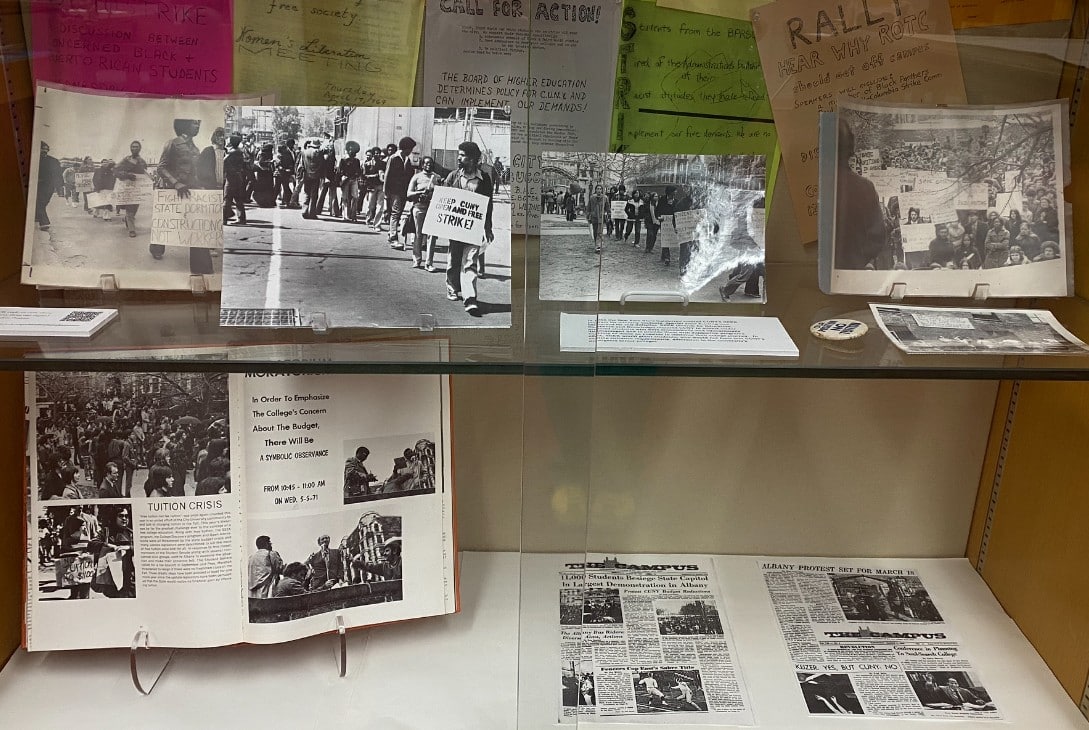
The Five Demands display is a prominent part of the exhibit. Black and Puerto Rican students and others took over the campus in protest in 1969 and demanded five things that would make it possible for minority students to come to City College and succeed. The black and white photographs show Black and Latino students marching through campus holding posters that called for equality and opportunity at CCNY.
“What they were trying to do,” Van Nort explained, “was to create a better environment, particularly for minority students of the college. One of them being that the racial composition should more accurately reflect the then minority population of students as they were increasing in the 1960s. They thought the racial requirements were too restrictive and not allowing as many minorities into the student body.”
By the Fall of 1970, there was a policy of open admission within city universities that stated any student with a high school diploma in New York City could get a place in any university. Though the CUNY board had already approved it, the Five Demands protest accelerated open admissions. “The college was just bursting at the seams with the influx of students in the classes in the 1970s,” Van Nort said. “Today, we have Caribbean and Latino studies and Black Studies as a result. The students at the protest wanted their peers to learn Spanish so that they could communicate with their Puerto Rican and other Latino students within their classrooms.”
Van Nort hopes that students and others come to see the exhibit and learn about the history and the important and interesting things that happened on campus. She said, “One thing we want is students to get a sense of their own place. That students have an active voice through their clubs, through demonstrations like the Five Demands. Students from the past expressed themselves in different ways, in different organizations. And current and future students can do the same!”
Tags: Archives & Special Collections CCNY Samantha Chevez student history exhibit at City College Student Life Sydney Van Nort The Five Demands
Series: Community