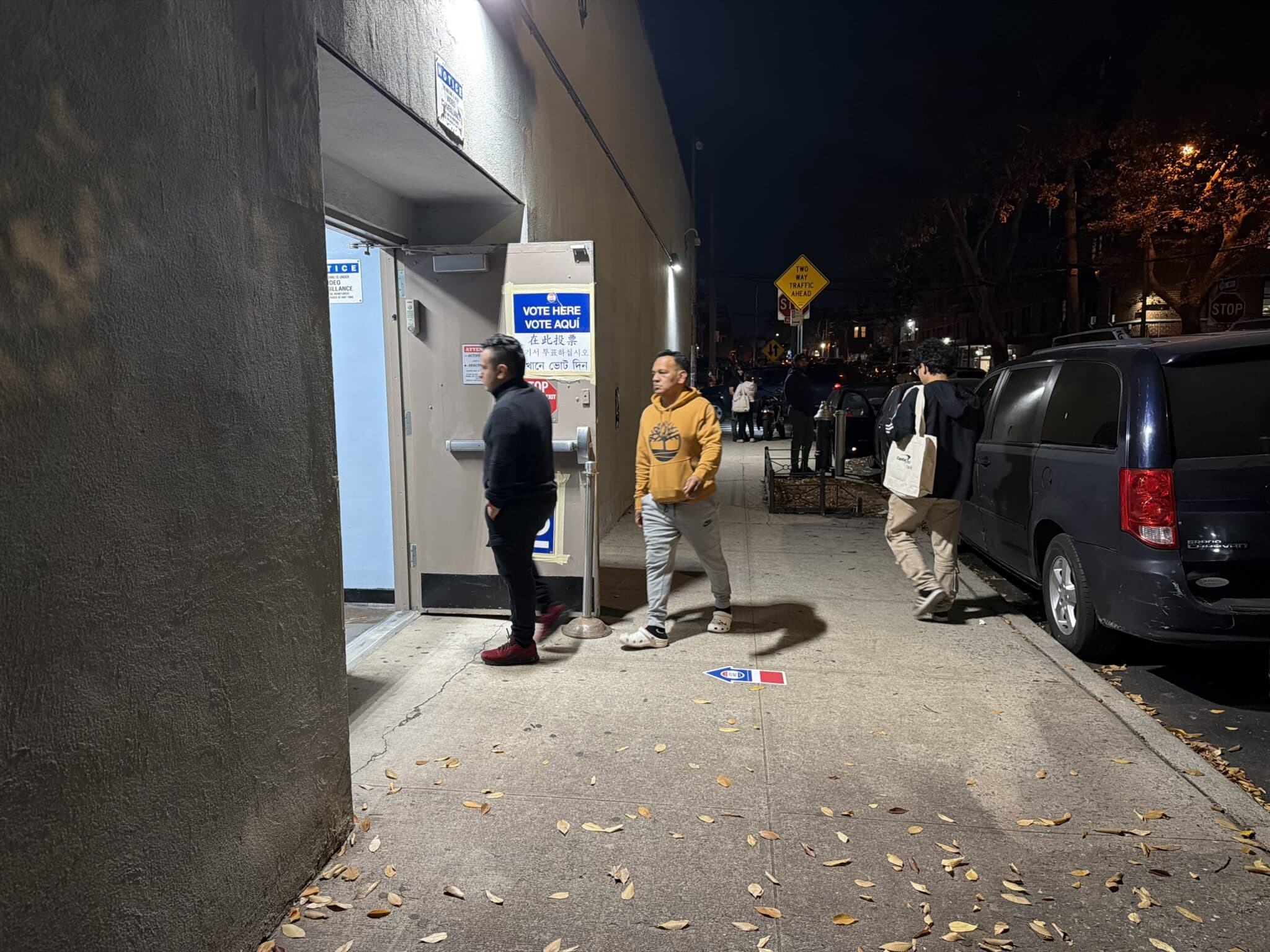
Voters wait their turn to cast ballots at Arts and Business High School in Corona, Queens, on Election Day, Tuesday, November 3, 2026. Photo by Esraa Khalifa
A high-stakes midterm election becomes a referendum on President Trump’s administration as voters seize the opportunity to course correct and reshape Congress.
NEW YORK
Federal immigration policies, rising prices and the future of American democracy brought voters from across New York City to the polls in this midterm election, hoping their votes would help steer the country in a direction different from President Trump’s.
“It’s pretty frustrating that the person who is supposed to be leading this country is actively fighting against the general public,” said Matilde Chabau, 20, while voting in Mott Haven on Election Day.
“I voted democrat because I believe in the protection of social services and civil rights,” Chabau said. “I hope my vote is able to shake the Senate, ensuring the Democrats are the majority. We’ll hopefully be able to take some of our power back and not continue backtracking the progress we’ve made as a country.”
By late election night, voters well beyond the city echoed Chabau’s sentiment with a resounding rejection of the Trump administration and delivered Congress to Democrats. For many, the midterms were an opportunity to make their voices heard on federal policies affecting their families and communities negatively — chiefly, Immigration and Customs Enforcement (ICE) tactics driving fear and the skyrocketing prices of groceries and gas.
Despite logistical challenges, including remote learning for the city’s public school children and inconsistent voter information in certain areas, more than a dozen New Yorkers interviewed in Brooklyn, Manhattan, and the Bronx said participating in the election was particularly critical this year.
“We really need a significant change right now, or it’s just gonna get worse,” said Natalie Phipps, 43, a mother of five who lives in Harlem.
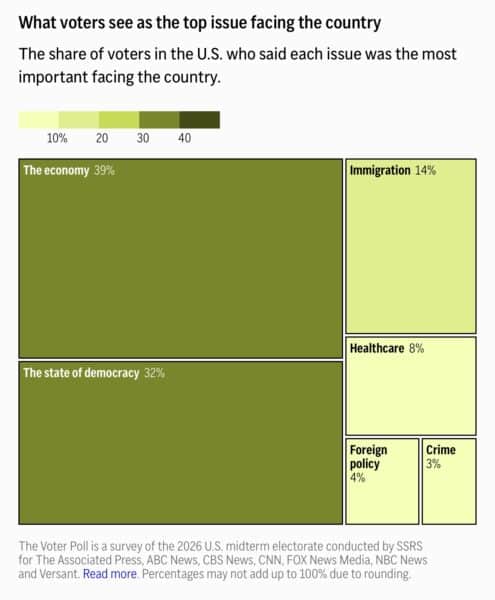
Source: AP News
ICE, Trump’s immigration enforcement sparked voter discontent
Federal immigration shifts and ICE’s treatment of immigrants, including those authorized to be in the U.S., were central concerns among other voters.
Dayanara Medina, 20, said she voted all blue because ICE has gone too far overwhelming. Her father, for one, she explains, endures pain on a daily basis partly because he is too afraid to go outside because he fears that he will be tackled and detained, even though he is a legal U.S. resident.
“Whether [immigrants] entered the country legally or illegally, it doesn’t justify all the abuse that they are receiving,” said Medina, also of Mott Haven. “I believe that this electoral vote will bring the change that this country needs.”
In Washington Heights, Rafael Castillo said he too was troubled by the way Hispanic and immigrant communities are treated.
“It’s crazy that they see us as second class citizens,” Castillo, a U.S. citizen, said.
Ziara Naranjo, 20, interviewed in Bushwick, said she voted for Democrats in direct opposition to Trump.
‘I expect this vote to allow us to remain free people in a free country,” Naranjo said. “I don’t agree with what the current president is doing with ICE and if we get more Democrats in the House, we will be able to push out this corrupt, colorist system we have.”
Dissatisfaction with Trump also motivated first-time voter Kevin Mckenzi to vote in the election.
“He’s not a good president,” said McKenzi, 19, who voted at P.S. 219 in Brownsville. “I can see where he is coming from on a few things but most of his view points are off the rails. It’s always hit or miss with him.”
Economic strain a major motivator
Phipps also described the financial strain families face, particularly single parents like her.
“We’re living check to check,” she added.
Similar economic concerns also motivated younger voters, many of whom lamented the high cost of housing.
Mckenzi, who works in security services, said he was voting primarily because a significant portion of his check went to taxes, while housing in even low-income areas like his remains unaffordable.
“Housing is both expensive and there isn’t enough,” he said.
For Chabau, the reduction of funding for social service programs such as SNAP food benefits and healthcare has also made life more expensive for Americans.
In discussing cost-of-living concerns, some voters said the administrations of New York Governor. Kathy Hochul and New York City Mayor Zohran Mamdani persuaded them to choose blue.
Arissa, 25, of Bushwick, said she voted for proposals on the ballot aimed at cutting red tape for building construction and things like bike and bus lanes.
“They, I think, were all endorsed by Zohran, which always makes me feel good because I think he’s got a really great eye for what the city needs,” she said.
Exercising a right for those who can’t
All interviewees shared a key reason for voting this year: performing their civic duty, in part on behalf of those who cannot because they are not eligible to vote.
“I want to be able to use my voice to speak up for those who can’t,” Chabau said. “These issues are very concerning, considering it [ICE] places the security of many communities at risk, and it promotes hate and violence against immigrant communities.”
“I voted to continue having a voice and sharing my voice for others who can’t vote because voting is a right, not a privilege,” said Naranjo, who is Hispanic.
Claudia Calhoun, a Harlem resident and mother of three, emphasized the importance of the civic duty.
“It’s always important to me to vote in as many elections as I can — the big elections, the small elections,” Calhoun said. “When I can, I bring either my daughter or my sons when I go vote to show them how important it is.”
Turnout strong despite barriers
It seems no election would be complete without some obstacles.
This year, one fell on parents, who had to navigate remote learning for public school children and parent-teacher meetings in some districts. Those who had flexibility with work and childcare managed to juggle both, while others struggled. In both scenarios, many kids accompanied parents to the polls.
“Ultimately, I had to manage my child’s school day while managing my work day,” said Megan Washington. “I’d prefer there is no school on Election Day.”
Series: Community