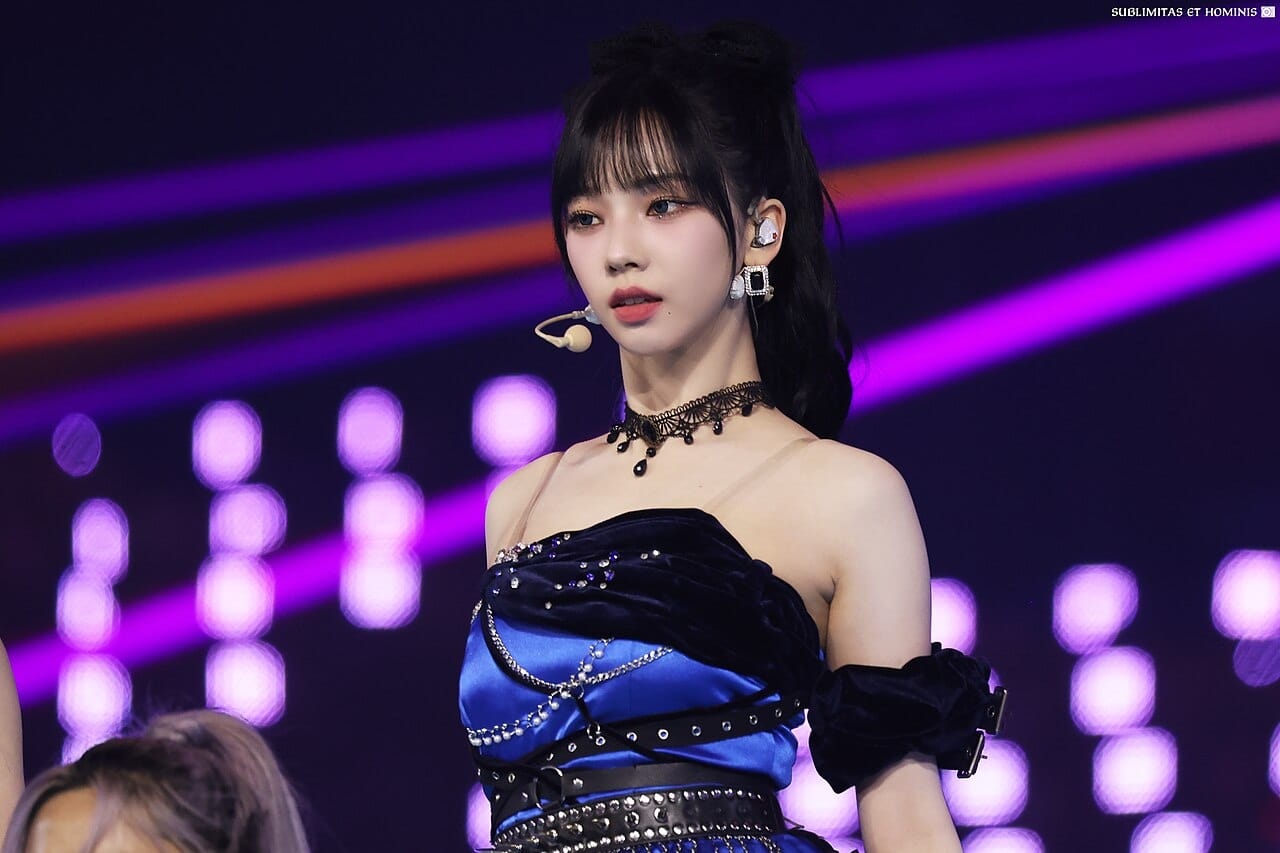
Photo of Karina by Plumflower Snow. Creative Commons
PBrooklyn, New York
In early 2024, when spring was slowly starting to bloom, a storm hit the K-pop world. Karina, a member of the popular group Aespa, announced that she was dating actor Lee Jae Wook. This announcement sparked a whirlwind of mostly angry reactions from her fans that highlighted the range of parasocial relationships in the K-pop community. In one instance, a group of outraged fans hired an electric billboard on a truck to express their disapproval of the news. According to CNN, the billboard on the truck demanded an apology from Karina and threatened to harm album and concert sales. Another billboard message read, “Do you not get enough love from your fans?”
The intense reactions surrounding Karina’s dating news are an example of a larger phenomenon where fans form parasocial, or almost fanatical and idolized one-sided relationships with stars and celebrities they really don’t know. The concept of parasocial relationships goes back to the 1950’s and the early days of TV when people began to think of TV stars as their friends, or familiar people. Social scientists Donald Horton and R. Richard Wohl identified it in their paper “Mass Communication and Para-Social Interaction: Observations on Intimacy at a Distance.”
In the K-pop world, at one end of the parasocial spectrum are fans who have intense emotional connections with the idols like the fans who had out-sized reactions to Karina’s revelation that she had a boyfriend.
After the billboard incident and the threat to harm album and concert sales, Karina posted an apology letter on her Instagram account expressing remorse about how the news had affected her fans. Although she removed the original post. It seems to have reposted on X by Popbase, a media and news company focused on pop culture. In her letter, Karina said, “I know many of you may have been disappointed, and I’m aware of the sadness recalling our shared moments brings. I deeply regret and apologize for any hurt.”
Karina, whose real name is Yu Ji Min, also won support from many fans and those fans defended her against others who were angry with her. In Karina’s Instagram post, after her apology letter was removed, a fan commented, “You deleted the apology letter 🥺💙 We love you Jimin 💙💙 enjoy your day 🫶🫶🫶.” The supportive fans highlight the other, healthier end of the parasocial relationships within the K-pop community.
According to a 2022 survey conducted by Thriveworks, a mental health care provider, 51% of Americans have likely been in a parasocial relationship, while only 16% have actually admitted to it. The survey also showed that the likelihood of a person being in a parasocial relationship decreased the older they are. People ages 16 to 24 are 31% likely to engage in parasocial relationships, but people ages 45 to 54 are only nine percent likely.
People tend to associate parasocial relationships with only extreme emotions and actions. Kenzy Hassan, a theater student at The City College of New York (CCNY), said that to her, a parasocial relationship is “just another word for obsession.”
Caption: Hassan on parasocial relationships in the K-pop community
Hassan joined the K-pop community during COVID-19. To her, the phrase “parasocial relationship” in the K-pop community is associated with someone who is obsessed with their idols. However, not all parasocial relationships are extreme. Some sociologists think they are okay unless people really believe the fantasy.
For example, Greyci, another theater major at CCNY , described her relationship with people she idolizes and said, “I’ll do my best to support you even if you don’t know me. I’ll call you my husband if you’re not, but it won’t pass from there.”
Caption: Greyci on her relationship with people she idolizes.
Although many fans do maintain a healthy parasocial relationship with people they idolize, there are those who go to extreme lengths and create toxic parasocial relationships. There have even been cases in which “sasengs”, obsessive K-pop fans, have heavily invaded singers’ private lives and broken into their homes.
Most fans have voiced concern about the actions against the obsessive fans in the community. Some fans worry that obsessive fans may the stars and celebrities emotional distress. “I do think that it affects them a lot because that eventually leads to hiatus,” Greyci stated.
But others think the obsession directed at the superstars is the price of fame.
Many fans share the sentiment that fans who are being extremely parasocial and obsessive are ruining the experience and fun for the rest of the community. They hope that those fans will come to understand that idols are also human beings and that ultimately being an idols is just a job.
Photo by Plumflower Snow. Creative Commons License via Wikimedia.

Tags: Fandoms Idols Instagram K-POP Karina and obsessed fans Karina's dating relationship and K-pop fans Merina Begum obsessed K-pop fans Parasocial Relationships Pop Culture Social Media
Series: Community