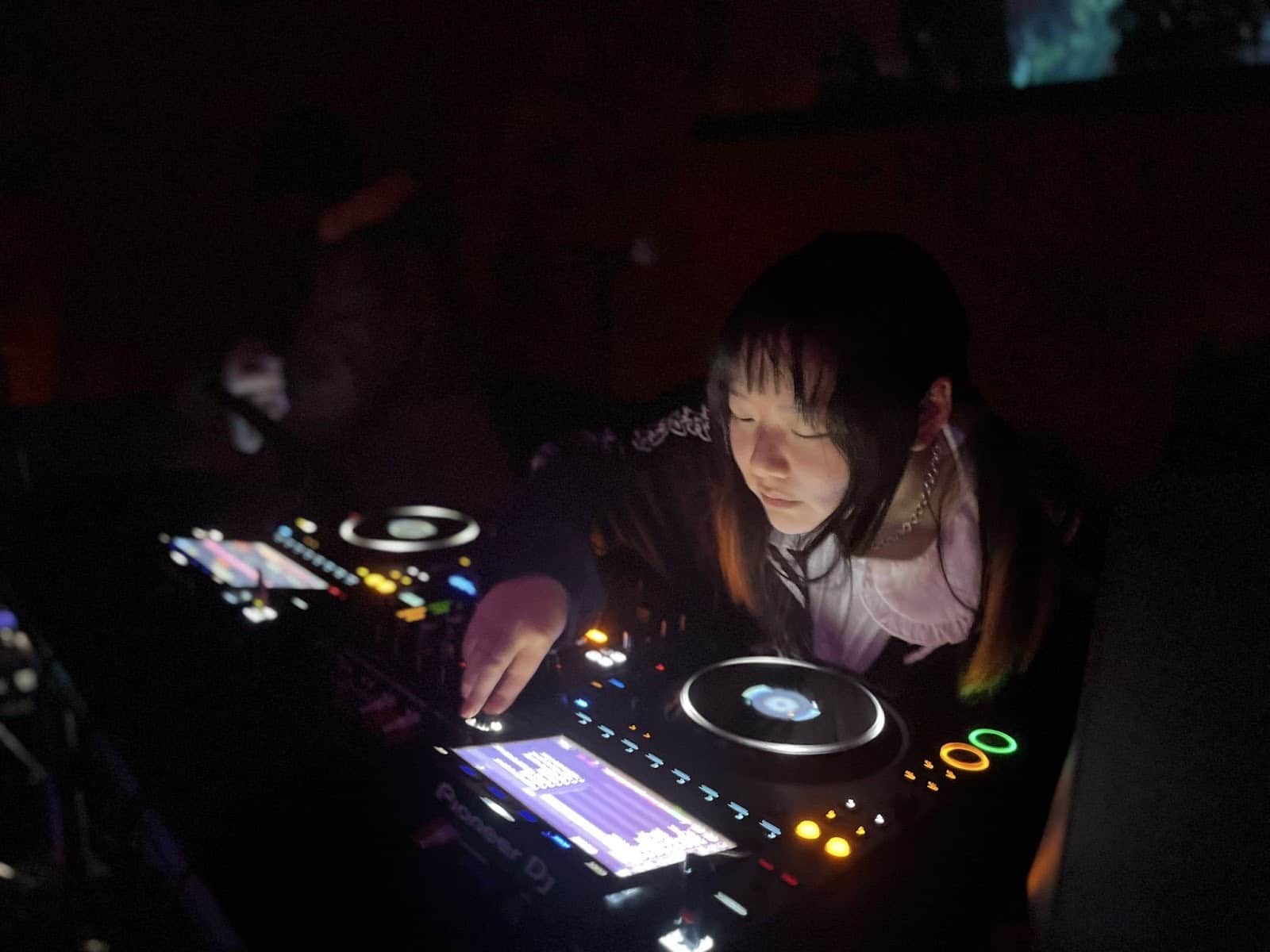
Jennifer Lee can trace her love of DJing a few years back to the nights her brother snuck her into raves. As a teenager, she slipped into clubs like one hidden in the back of a fried chicken shop, getting past the entrance only after her older brother bribed people to let her in. But she wasn’t focused on the crowds. “I would always look at the DJ,” says Lee. “I was always really interested in what they were doing.”
That early fascination eventually pushed her to learn how to DJ herself.
Lee, now 24, followed that path into music that came not from formal training but from curiosity, repetition, and the underground scenes she grew up watching. The advertising/pr major’s story reflects something many artists can relate to: no formal training, just passion.
Lee, from the suburbs of Queens, can pinpoint the moment she first used DJ equipment. “I think I was 20 or 21 and my boyfriend had a Serato controller, and he left for Texas and let me use it for the summer,” she says. Having access to that controller became her first real chance to practice. “So that’s kind of how I taught myself how to do it,” she explains. “But I was mixing music on my laptop before.”
She started with casual sets at house parties mostly in Brooklyn playing under her artist name babygh0st and spent time teaching the basics to a friend named Yoshi, who was also learning. “I was, like, showing him how to do it,” she says.
When he landed a small gig at a Brooklyn club called Baby’s All Right and invited her to join, it meant she had to get comfortable with club equipment. “At the club you can’t bring a controller. You have to do it on these things called CDJs, which are like $10,000,” she says. To prepare, she rented time at Pirate Studios, where DJs can book rooms with CDJs.
Practicing there shaped her routine. Without equipment at home, she prepares for gigs entirely at Pirate Studios in Ridgewood, going a few times before each show and paying for every session. “I don’t DJ for money,” she notes. “I just do it for fun.”
Lee drew inspiration from seeing the DJ Machine Girl perform. Her sets jumped between genres in a way she calls “super ADHD.” That approach stuck with her. “I really like mixing up genres,” says Lee.
When shaping the mood of her sets, Lee adjusts to the crowd. In the East Village, “people want to hear house music.” In Bushwick, especially in gay clubs like Rash or Paragon, it’s “what the gays want to hear,” leaning into tracks with more attitude and bounce to match the room’s energy. If she plays for a more emo crowd, she switches to hard techno or jumpstyle. “I always want people to be dancing,” she adds.
Lee remembers her most memorable performance as a show at Oberlin College in Ohio two years ago, where she opened for Junglepussy. “It felt like doing a festival,” she says of the largest crowd she’d ever played for, about 200 people. “I think it was, like, right after finals week, so everyone was going so hard and crazy.” Her friend Saoirse Dempsey, an Oberlin College alum, remembers it clearly too: “Everyone was going crazy, people were jumping up and down. She was super nervous before she went on, but once she started, she calmed down.”
As she shapes what the next phase of babygh0st will be, she leans further into building her own sounds. “Now I like doing cunty music,” she says, referring to a style reflecting a fierce, confident, and glamorous attitude and signals Lee’s growing confidence. “Ideally I would like to turn this into a career.”