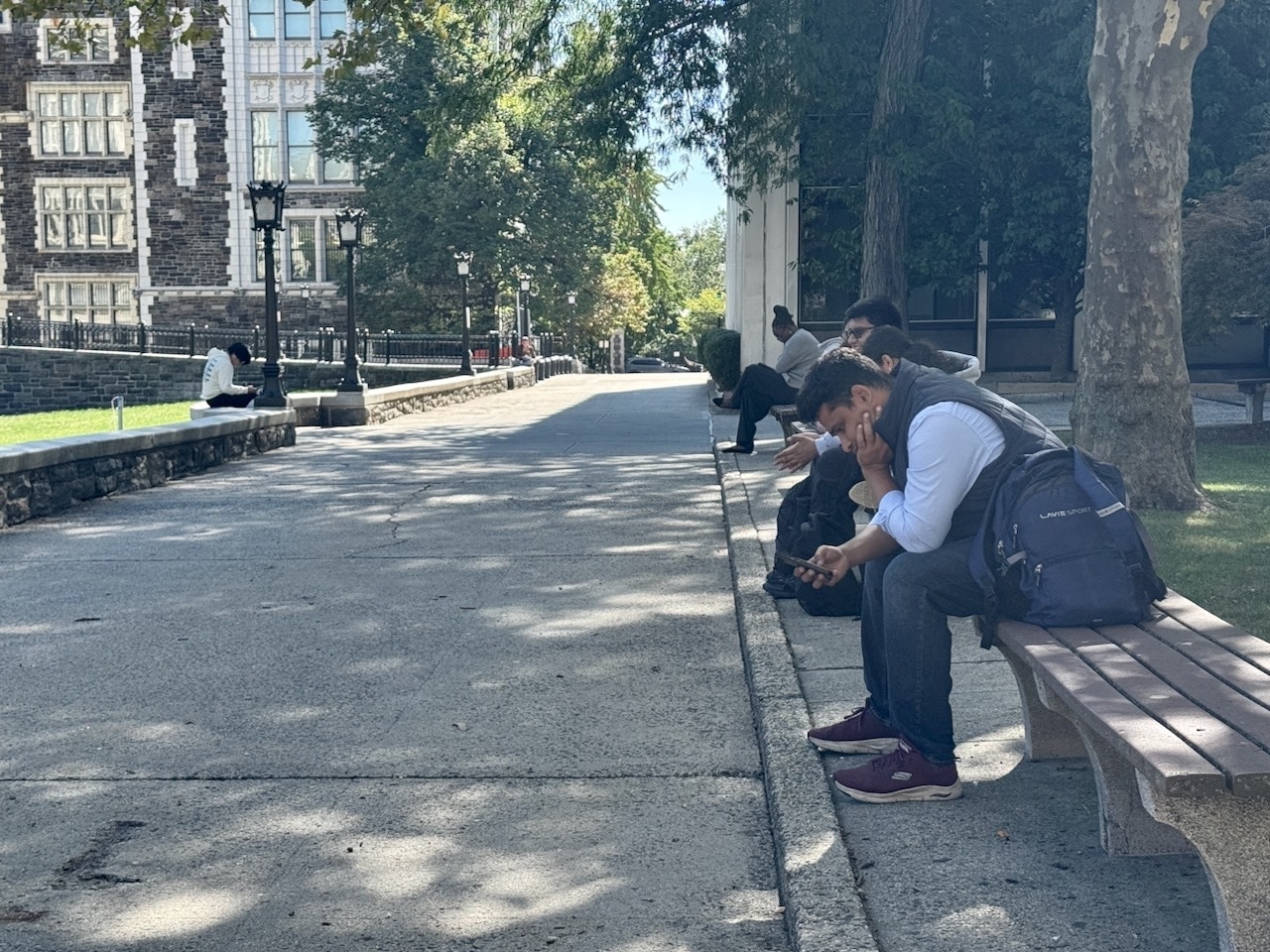
Students sitting alone on The City College of New York campus.
OPINION
At a commuter school like The City College of New York (CCNY) creating and maintaining bonds is not easy. Most students head straight home after class. That makes the campus a difficult place to form deep connections. Still, it’s important to engage in small interactions. Brief exchanges like grabbing a classmate’s phone number, or saying good morning to a security guard can make the day more bearable. Though these quick moments don’t immediately lead to strong relationships, they can open people up and make them feel less invisible in a space that might otherwise feel isolating.
Commuter schools can feel transient compared to colleges where students live on campus. These schools provide places for students to easily connect with each other. Commuting to campus, the act of physically getting here becomes another task for students to complete, alongside work and other obligations. Despite being surrounded by peers, many feel they are moving through college by themselves.
“A majority of the time, I go to campus, get my class participation, and go straight home or to work. I don’t usually go out of my way to have conversations with people I don’t know,” Lucas Ayala, a junior at CCNY said. Though many behave the same way, tiny interactions could warm things up.
A study by professors from Sabanci University published in Sage Journals examined the link between minimal social interactions – brief exchanges with acquaintances or strangers – and overall life satisfaction. The study found that even fleeting connections can meaningfully contribute to happiness. Researchers discovered that casual social contact predicted greater life satisfaction, suggesting that expanding one’s networks fosters a sense of belonging.
“Its easy to get through the day without conversing with people outside of my immediate circle,” said Emma Gukasyan, a student at Borough of Manhattan Community College. “On days where I feel more social and put myself out there, I feel better – like the day’s not passing me by.”
Beyond the beneficial effects that minimal social interactions have on an individual’s happiness, they can also contribute to a stronger campus atmosphere. A more tight-knit community doesn’t necessarily require huge campus events or extensive time commitments to extracurricular activities. Instead, a positive campus culture can be born out of light conversations and simple greetings.
Even in the absence of conversation, something as simple as being acknowledged – whether through a smile, a head nod, or making eye contact – is suggested to positively influence our well-being.
“I mostly see the same people every time I’m in the library. After a while, I grew accustomed to being in the same space, and it became something to look forward to. It’s like, ‘okay I have to do this thing, but at least I’ll probably see this person,’” said Gukasyan.
Researchers also compared the effects of minimal social interactions with close relationships, like receiving kindness from friends or family. While close relationships were shown to have a stronger impact on well-being, minimal interactions still had notable effects, especially because they didn’t happen frequently.
The study found that individuals who receive less support from their close relationships benefitted even more from interactions with strangers and weak ties. This suggests that small, casual daily exchanges can partially compensate for limited social support in other areas of life. For students that might mean smiling at the people you see regularly, getting to know the person who sits next to you, or chatting with your professor after class. When these acknowledgements get repeated over time, they can build familiarity and a sense of belonging. Not only does this strengthen campus culture, it also lays a foundation for enhancing students’ overall life satisfaction.
On a campus where a large majority of students are commuters, even quick exchanges can make the difference between feeling anonymous and feeling like a larger part of something. So next time you hesitate to compliment a classmate’s outfit, or are embarrassed about asking for directions, remember that connecting with another human being can brighten someone’s day – and yours.
This essay was supported and written in collaboration with the Social Mobility Lab in the Colin Powell School for Civic and Global Leadership.
Series: Social Mobility Lab