Goats bring people to Riverside Park. Photo by Phoebe Estep.
*Phoebe Estep was a student in the College Now Introduction to Journalism class at CCNY.
July 25 was a hot and sunny day. Highs in the 90s, and not a cloud in the sky. Despite the relentless sun, many people stretched out on the grass sleeping in Central Park’s Sheep Meadow. Two young men passed a football back and forth, and a family had set up a badminton net in the shade of the trees. A woman and her daughter sat watching the game on a picnic blanket. Haya and Mia Segal were visiting New York for the week, and were enjoying their first time at the Meadow. When asked whether or not they could imagine sheep on the lawn, Haya said “I think it will attract even more people.” That seemed to be the consensus of everyone I spoke to at the Meadow, tourists and natives alike.
Between 66th and 69th street in the center of Central Park lies the pastoral landscape of Sheep Meadow. The 15 acre lawn seems to have everyone including college students, excited puppies, first dates, and big families. The one thing it’s missing, despite its name, is sheep.
The reason for the name of one of Central Park’s most iconic parts has been lost to history. Beginning in 1864, Central Park’s Sheep Meadow hosted a flock of sheep that not only kept the grass short, but added to the Romantic English style landscape the park’s architects Frederick Law Olmsted and Calvert Vaux were attempting to achieve. The sheep were removed from the meadow in 1934, but 85 years later, New York City’s parks are revisiting the idea of bringing grazing animals to needed green areas.
In the past years, parks around the country have been adopting a century-old trend of using grazing animals like goats to help keep their parks healthy. I spoke with Riverside Park Conservancy’s Communications Manager Alison Ettinger-DeLong about the summer goats. Since 2019, five goats have been spending their summers at Riverside Park helping get rid of invasive and harmful species.
“It’s something light-hearted and good in the world,” Ettinger-DeLong said when asked about how the public was responding to the goats. “And I think people always need more of that right now.”
This new trend has introduced unexpected benefits—the goats have done wonders for their local communities. In an age of social media and individualism, communities seem to fall apart. People spend less and less time outside connecting with their neighbors and appreciating the natural world around them. The goats that have inhabited Riverside Park for the past few years have been admired by their human neighbors.
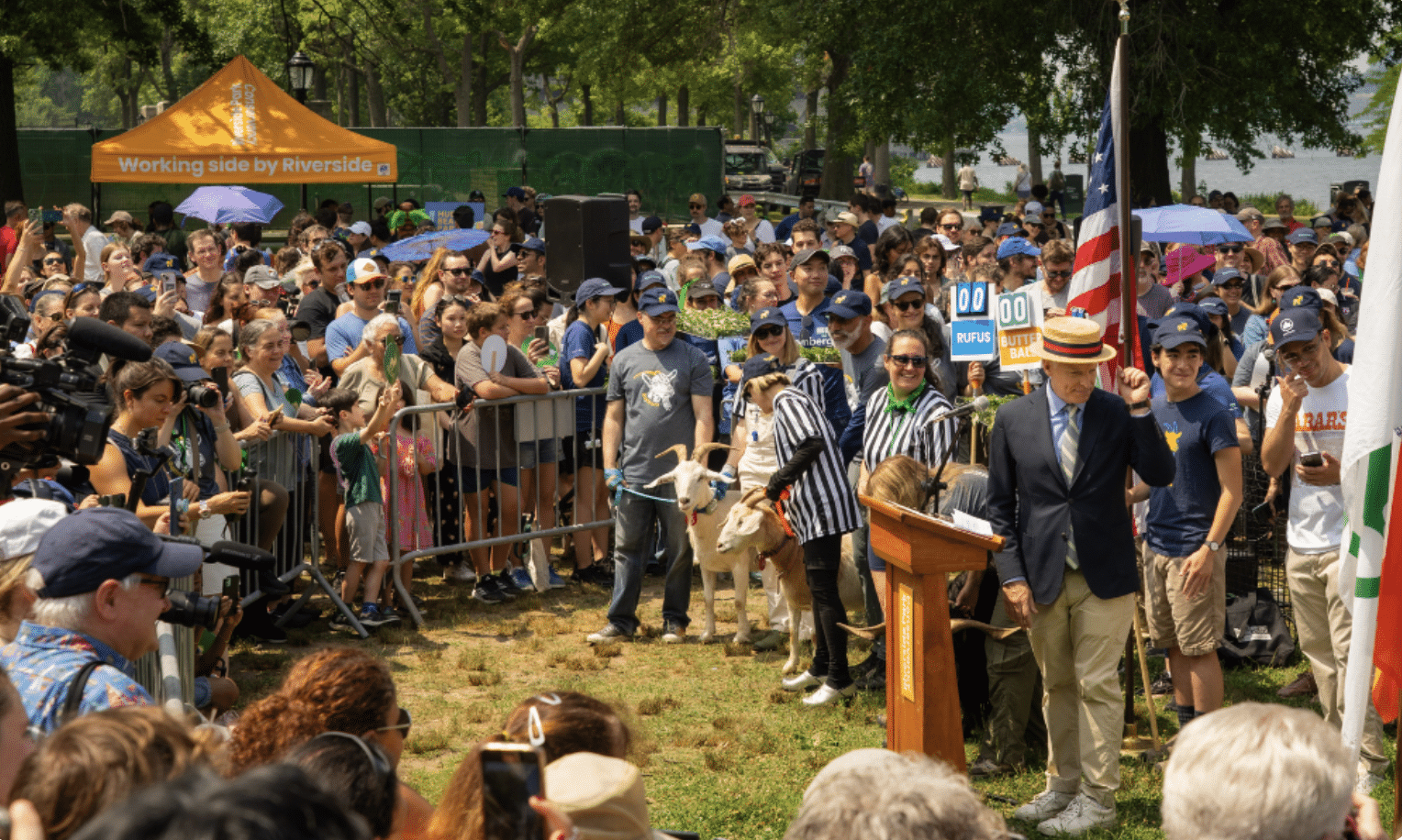
On July 12, Riverside Park Conservancy held their second annual eating contest between their five goats. Romeo, Mallomar, Butterball, Kash, and Rufus faced off to see who could eat the most weeds. The competition was mediated by George Shea, who had just hosted his famous Nathan’s Hot Dog Eating Contest on Coney Island a week prior. Tension and celebration rose, and soon the experienced Mallomar was crowned victor. “You could say that his Veteran experience in Riverside Park prepared him for victory,” Ettinger-DeLong said.
The contest attracted a large audience from around the city. Ettinger-DeLong estimated a turnout of around 2,500, including Council Members Shawn Abreu and Gale Brewer, New York City Parks Commissioner Iris Rodriguez Rosa, Manhattan Parks Commissioner Tricia Mura, and of course numerous organizers from the Riverside Park Conservancy.
But these goats have done more than just bring a turnout to a fun competition, they have become beloved members of every neighborhood they join. Their presence, “adds something really special that people have in their backyard,” Ettinger-DeLong said. “I’ll talk to people who are bringing their kids or bringing their dogs.” She recalled the many locals who have incorporated the goats into their daily routines. “It’s part of their summer in New York, which is so wonderful.”
These goats are far from the first animals to graze the urban lands of New York—and they’re not going to be the last. These goats may signal a renaissance of the urban pasture, both as a cost effective solution to invasive species, but also as the glue that keeps communities together.
That brings us back to the Sheep Meadow in Central Park. Sheep Meadow was created as one of many open fields in Olmsted and Vaux’s Greensward Plan of 1858. They had created an English farmland of rolling hills in the middle of one of the world’s most urban settings. A 19th century pastoral landscape would not be complete without a flock of sheep, and in 1864, 200 of them were introduced to the Meadow. In 1871, Jacob Wrey Mould designed a sheepfold to house the flock in what is now the well known restaurant Tavern on the Green. In the 1910s and 20s, the sheep shared their Meadow with folk-dancing festivals, pageants, and celebrations. Although modern day journalists can’t ask the park goers of the 1800s about their personal thoughts on the sheep, it’s been confirmed that they were integral to Central Park’s social scene.
Central Park’s sheep, in 1934, the sheep were moved supposedly temporarily to Prospect Park in Brooklyn. But they eventually left the city. In the late 1960s and 70s.
Fred DeJesus, or as he called himself Fred “don’t F with me” DeJesus, grew up in Queens. Standing on the now bright green lawn, he recalled the parades at Sheep Meadow that his parents would bring him and some of his eight siblings to when he was young. “For the Puerto Rican parades, forget about it. Thousands of people came here from all over the city,” he said. After retiring a week ago from his job as a doorman, he is planning to spend his days out in the park with his wife Theresa soaking in the summer sun. Theresa, who was writing a heartfelt letter to her son, said she would love to see sheep in the Meadow. “For me, there is a space for everybody,” she said. “How many sheep can we put here? It can be millions, and there is space for us too.”
The goats in Riverside Park serve as an inspiration for what can happen in Central Park. “The goats are super beneficial for the slopes and removing invasive species,” said Ettinger-DeLong, noting, “but the way they also make people happy is why we keep bringing them back year after year.”
Series: High School Journalists